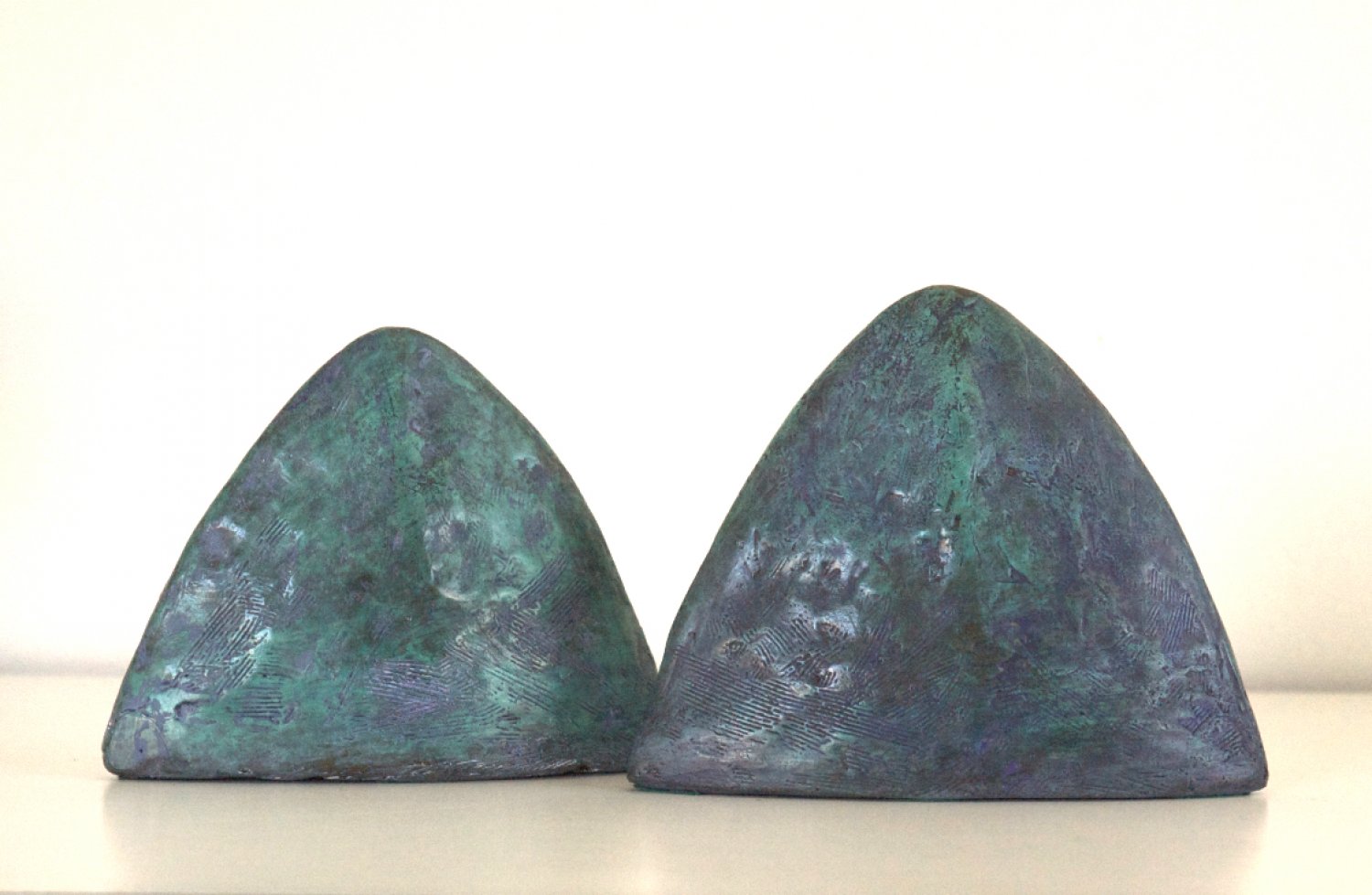
Marea Gazzard
Eocene, 2008
bronze
9.8 x 12.5 x 4 cm; 10.8 x 13.5 x 4 cm; number 1 from an edition of 5
with certificate of authenticity from Utopia Art Sydney dated 3 September 2008
Provenance
Utopia Art, Sydney
Acquired from the above on 3 September 2008
Exhibited
Thalassia, Utopia Art Sydney, Sydney, 9-30 August 2008, cat. 17
Literature
Christine France, Thalassa, Utopia Art Sydney, 2008, exh. cat., illus. unpaginated
'Marea Gazzard's new body of work Thalassa has extraordinary vitality. Her strong command of space, her clear forms and light-filled colour are elegantly minimalist. Yet they exhibit, what has always been the essence of Gazzard's work, an innate feeling for the primeval origin of things, the mystic beginnings of all life and forms....
In all Gazzard's work there is some primeval form that she has perceived and evolved until it attains a modernist perfection while preserving the suggestion of a distant time or deep-seated feeling of life hidden within the sculpture....
As in the triangular forms of the sculpture Eocene, the colour of the works has been chosen, not for its descriptive qualities but to achieve the level of light dictated by the artist's formal conception of the work. In Eocene it gives weight and depth to the overlapping forms and reveals the rich workings of the surface with subtlety." (Christine France, Thalassa, Utopia Art Sydney, 2008, exh. cat., unpaginated)
Image courtesy of the Estate of Marea Gazzard and Utopia Art Sydney
Marea Gazzard was one of Australia’s best known ceramic artists and an influential figure in elevating the status of craft objects to the level of fine art. Born to Greek-Australian parents in Sydney in 1928, Gazzard studied at the Central School of Arts and Design, London (1955-59), where she was influenced by the hand-building ceramic techniques of British sculptor Ruth Duckworth, and the National Art School, Sydney (1953-55; 1961), where she was taught by Lyndon Dadswell, the same sculptor who taught Robert Klippel and Tom Bass.
Gazzard's breakout exhibition came with textile artist Mona Hessing at the National Gallery of Victoria in a seminal show called Clay + Fibre (1973). The show was the first time ceramic and textile objects had received equal treatment as traditional works of art in a major Australian institution, provoking substantial debate on the distinction between arts and crafts. The legacy of that exhibition is a thriving and elevated crafts movement across Australia, with all major institutions having integrated ceramics, textiles, weavings and other objects into their collections.
From 1984-88, Gazzard worked on a public commission for the opening of Parliament House, Mingarri: The Little Olgas. A major retrospective of Gazzard’s work – Marea Gazzard: Form and Clay – was held at S.H. Ervin Gallery, Sydney, in 1994, with an accompanying monograph by Christine France. In 2013, just prior to her death, a survey of three decades of work was held at Utopia Art, Sydney. That year, one of Gazzard’s last major works, Selini I (2009), was installed in the portico entrance of the Art Gallery of New South Wales, Sydney (see below).
Gazzard was influential figure in the Australian art world in addition to her established career as a ceramic artist. She successfully lobbied for the founding of the Crafts Council of Australia in 1971 and served as the inaugural Chair of the Crafts Board of the Australia Council in 1973. She served as president of The World Crafts Council (1980-83), was a trustee of the Museum of Applied Arts and Sciences (1982-86) and the first recipient of the Australia Council’s Creative Arts Fellowship (1989-92). For her contribution to art in Australia, Gazzard was made a Member of the Order of Australia in 1979. She died in Sydney in 2013, aged 85.