
Drapery and wattle from the Buddens series, 2017
archival pigment print on paper
59 x 90.5 cm (image); 73 x 94.5 cm (frame); 1 from an edition of 8
signed, dated and inscribed ‘Rosemary Laing/Drapery and wattle/1/8 2017’ (on the reverse)
Provenance
Tolarno Galleries, Melbourne
Acquired by the present owner from the above on 12 September 2017
Exhibited
Another from the edition
Tolarno Galleries at Sydney Contemporary, Carriageworks, Sydney, September 2017
Rosemary Laing, TarraWarra Museum of Art, Healesville, 2 December 2017-11 February 2018
Buddens, Tolarno Galleries, Melbourne, 2018
Literature
Victoria Lynn & Judy Annear, Rosemary Laing, TarraWarra Museum of Art, Healesville, 2017, illus. p.73
Drapery and wattle comes from Rosemary Laing’s Buddens series (2017), a body of photographs taken on Budawang Country (Yuin Nation) on the New South Wales south coast.
Laing’s interventions in the landscape included a large timber roof frame, protruding from the landscape as if half-buried, and rivers of warm-coloured fabric lengths surrounded by rainforest foliage. Victoria Lynn has described these as evoking “human or ‘unnatural’ disasters” from Australia’s colonial and modern history.(1)
The titles of the Buddens works referred variously to stories of shipwrecks and rescues by Aboriginal peoples, as well as allusions to works by Margaret Preston and—in the case of drapery and wattle—Grace Cossington Smith, whose 1952 painting of the same title is in the Art Gallery of New South Wales’s permanent collection. In Cossington Smith’s original still life, golden wattle cuttings sit in a vase, surrounded by fabric arranged in small hillocks. In Laing’s image, there are echoes of Cossington Smith’s colours in the drapery river.
Of this series in the catalogue for Laing’s major 2017 exhibition at TarraWarra Museum of Art, Judy Annear writes: “In Buddens, as viewers, we stand in the middle of a flood gazing, unable or unwilling to provide shelter. We are also, if we think about it, looking at ourselves streaming past, blindly and contrarily upstream, towards what we hope will be survival and refuge, somewhere.”(2)
Annear then quoted Laing herself, who reflected on the passage of people through the landscape and the effects that even a moment of disruption can have both upon nature and the people who call that land their home: “The arrival of people, throughout history, shifts what happens in land, challenging those who have left their elsewhere, and disrupting the continuum of their destination place. A disruption causes a reconfiguration. It elaborates both the beforehand and the afterward.” (3)
1. Victoria Lynn, Rosemary Laing, TarraWarra Museum of Art, Healesville, 2017, p.10
2. Judy Annear, in Victoria Lynn (ed.), Rosemary Laing, TarraWarra Museum of Art, Healesville, 2017, p.16
3. Ibid, p,16.
Jack Howard, 2026

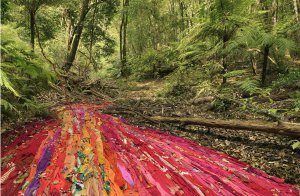
Image courtesy of the Estate of Rosemary Laing