
H142: First Female Aboriginal Seen and Captured Camp XL: Yarrundang II (dream) from the 'Gun-Metal Grey' series , 2007
screenprint in grey ink on metallic foil and cotton, 2 from an edition of 3
170.5 x 130 cm
signed, dated, inscribed and numbered ‘H142: First female Aboriginal seen/ and captured Camp XL, 2007/Yarrundang II (Dream)/B Andrew 2/3’ (on the reverse)
Provenance
Tolarno Galleries, Melbourne
Private collection, Brisbane
Private collection, Sydney
Exhibited
Brook Andrew – Come into the Light, Tolarno Galleries, Melbourne, 2007
Brook Andrew – The Right to Offend is Sacred, National Gallery of Victoria, Melbourne, 3 March – 4 June 2017 (another from the edition)
Literature
Judith Ryan, Brook Andrew, Nick Aikens, Anthony Gardiner, Marcia Langton, Simon Maidment and Trent Walker, Brook Andrew – The Right to Offend is Sacred, National Gallery of Victoria, 2017 illus. p. 71
In 2007, Brook Andrew collaborated with the printmakers Trent Walter and Stewart Russell at Spacecraft, North Melbourne, to create the Gun-metal Grey series. Each of the works in the series is an enlarged archival photograph from the collections of the Royal Anthropological Institute, London and Museum of Archaeology and Anthropology, Cambridge—a collection that Andrew has studied since the mid-1990s. Deliberately darkening each image, Andrew and Russell experimented to create a unique effect by screenprinting capped half-tone dots onto heat-set metallic foil. (Judith Ryan, Brook Andrew: The Right to Offend is Sacred, National Gallery of Victoria, Melbourne, pp. 18-19)
Marcia Langton has written about the Gun-Metal Grey series and related works from that time as “works [that] assault the intellect and senses with gigantism, shadows, neon, the brilliance of metallic materials, and the inescapable witnessing of sexual voyeurism and brutal, tragic and violent histories.”
Langton further wrote: “Barely visible because of the poor quality of the original photographs, these images demand that we tilt our heads and walk around the gallery to discern their secrets and elicit meanings. While some may think that effect might be the result of the high saturation of grey colour digitally applied to images of archival photo-portraits, this is not the case. The murkiness of the original photographs was part of the artist’s challenge; he was drawn by this quality and the mystery and sadness that it invoked in him.” (Marcia Langton, ‘Brook Andrew: Ethical portraits and ghost-scapes,’ Art Bulletin of Victoria 48, National Gallery of Victoria, Melbourne, 2008, available at https://www.ngv.vic.gov.au/essay/brook-andrew-ethical-portraits-and-ghost-scapes/)
Another work from the edition was exhibited in Brook Andrew’s major survey, The Right to Offend is Sacred, National Gallery of Victoria, Melbourne. Then Senior Curator of Indigenous Art, Judith Ryan, wrote about this work as follows: “Imperfections and surface losses in the original photographs become distorted into bodily scars and abrasions that have disturbing connotations in the voyeuristic H142: First Female Aboriginal Seen and Captured Camp XL: Yarrundang II (dream), 2007. Notwithstanding the poetry and ancestral gravitas of the figures’ elemental Wiradjuri titles, they rise up and soar beyond their New South Wales location through common experiences of colonialism ensured by disappeared First Nations peoples throughout the world.” (Judith Ryan, Brook Andrew: The Right to Offend is Sacred, National Gallery of Victoria, Melbourne, p. 17)
A Wiradjuri and Ngunnawal man from his mother's side, Brook Andrew's practice is grounded in meticulous historical research with works that confront the narratives of colonial history and memorialise the lives and stories that have been erased by the historical record. For several decades, Andrew's practice resembles that of an historian, trawling through archival documents to glean new insights into Australia's history divorced from what he calls the "Colonial Gaze". His prolific oeuvre includes photography, collage, sculpture and large-scale installations, informed to a large extent by his Australian Aboriginal heritage, culture and language. (Jack Howard, 2026)
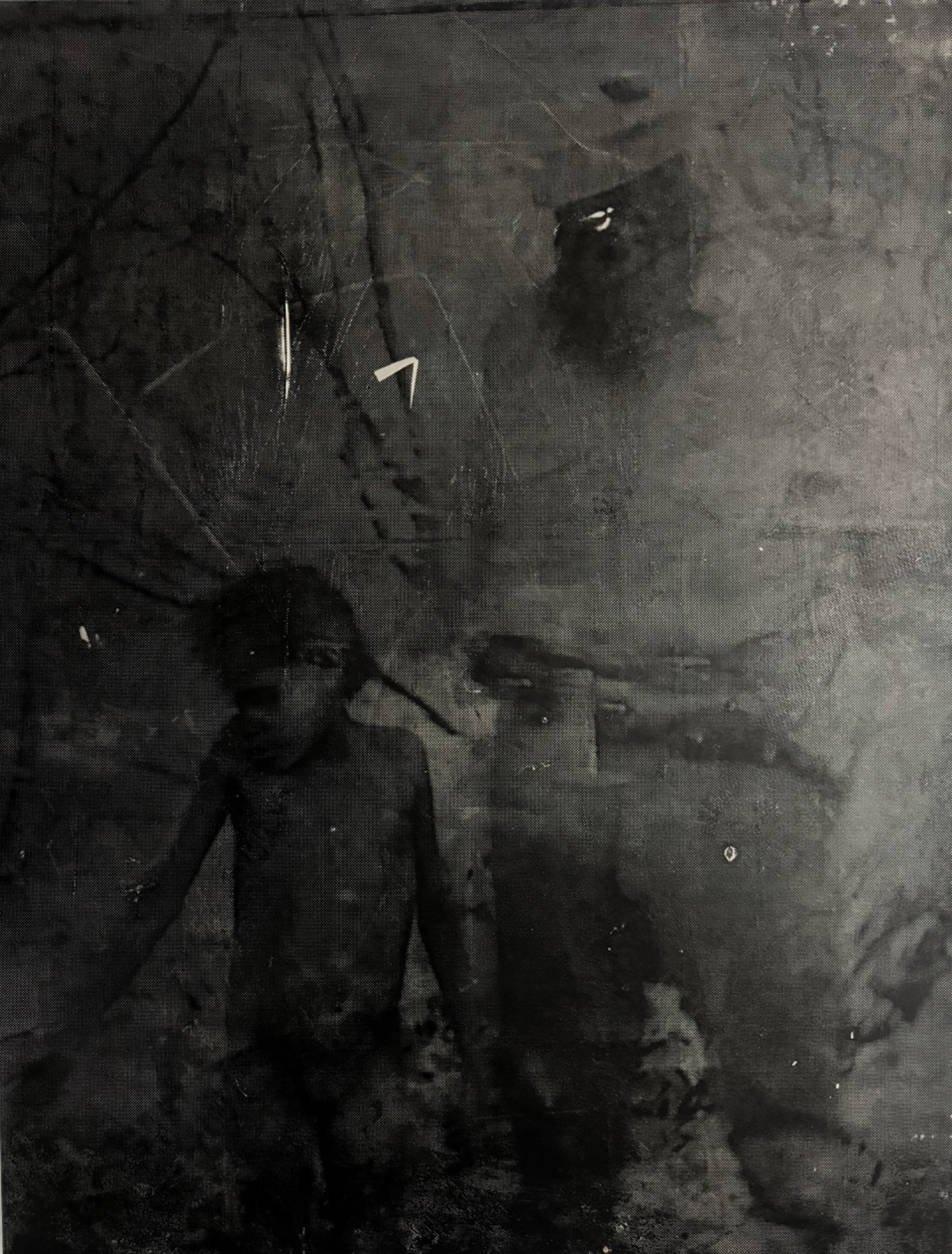
Image courtesy of the artist and Tolarno Galleries, Melbourne